
Book Designer
The Book designer command opens a guided setup panel that generates a manuscript scaffold for your project: scene files, act distribution, subplot rotation, characters, and optional beat notes.

Book Designer walkthrough · Full video on YouTube
Open Book Designer
Section titled “Open Book Designer”You can open Book Designer in two ways:
- Command Palette: Open the Command Palette (
Cmd + Pon Mac,Ctrl + Pon Windows/Linux) and search forRadial timeline: Book designer. - Welcome Screen: Under Set Book Project, choose → or open Book Designer.
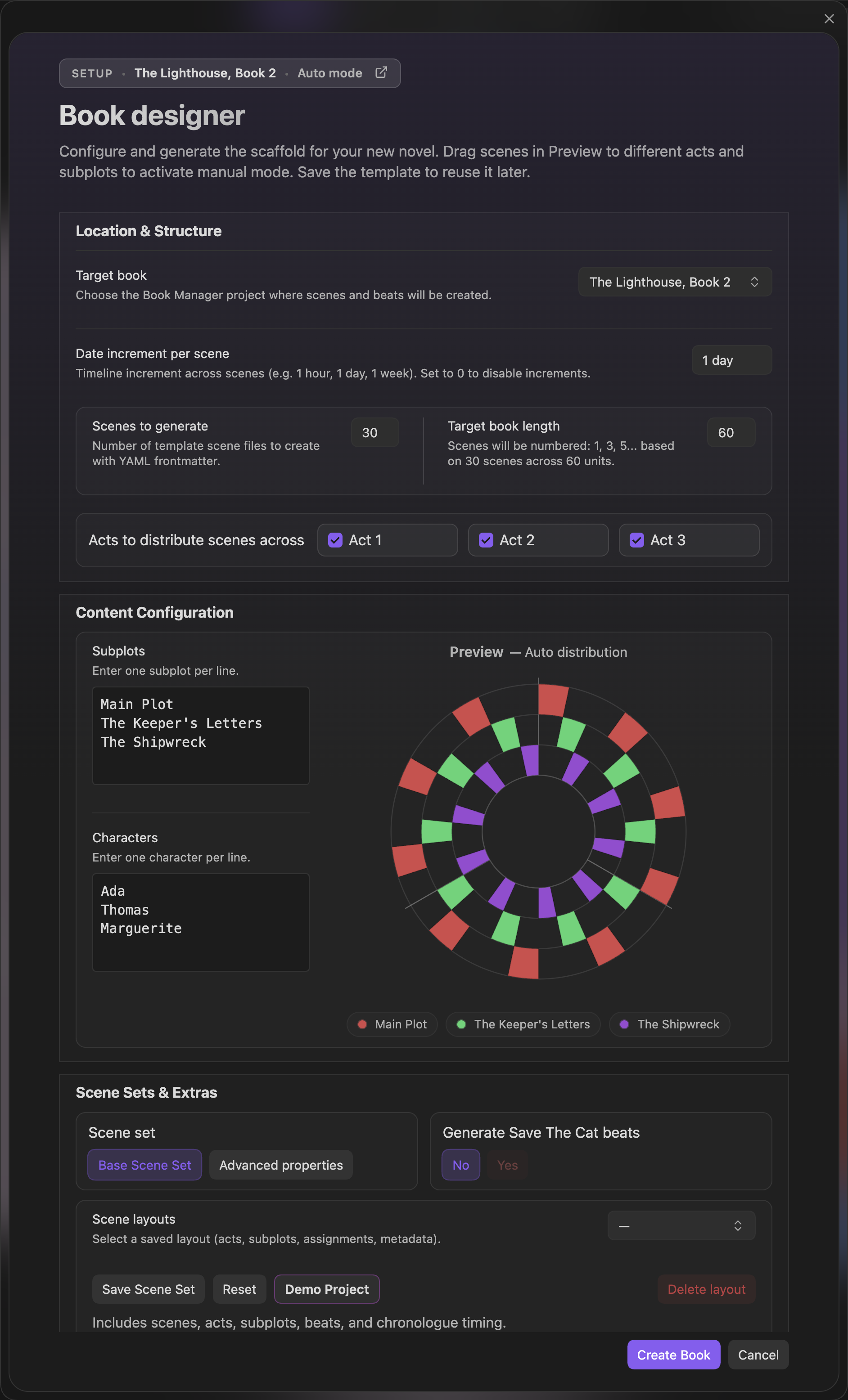
Book Designer — configure structure, subplots, and scene sets with a live preview you can drag scenes in
Workflow
Section titled “Workflow”The panel is organized into three main sections:
1. Location & Structure
Section titled “1. Location & Structure”- Target book: The Book Manager project where scenes and beats will be created. Add the book in Book Manager and set its folder first.
- Date increment per scene: How far story time advances from one scene to the next (e.g. 1 hour, 1 day, 1 week). Set it to 0 to disable increments.
- Scenes to generate: The total number of scene files to create.
- Target book length: Used for numbering distribution. For example, if you generate 10 scenes with a target length of 60, scenes will be numbered 1, 8, 14 … 60, leaving gaps for future scenes.
- Acts to distribute scenes across: Choose which acts (1..N) to populate, where N comes from your Settings → Core → Acts → Act count. Scenes are distributed evenly across the selected acts.
2. Content Configuration
Section titled “2. Content Configuration”- Subplots: Enter your subplots, one per line. Scenes will be assigned to these subplots in a round-robin fashion. Each scene will belong to only one subplot.
- Characters: Enter your main characters, one per line. These will be added to the YAML frontmatter of the generated scenes.
3. Scene Sets & Extras
Section titled “3. Scene Sets & Extras”- Scene set: Choose between the Base Scene Set (core properties) and Advanced properties. The advanced properties profile can be customized in settings.
- Generate beats: Named after your active beat system (e.g. Generate Save The Cat beats). Choose Yes to create beat notes alongside the scenes.
- Scene layouts: Save Scene Set keeps the current layout (acts, subplots, assignments, metadata) to reuse later; pick a saved one from the list. Reset returns to auto distribution. Demo Project builds a sample book with scenes, acts, subplots, beats, and chronologue timing.
Visual Preview
Section titled “Visual Preview”As you adjust the settings, the Preview donut chart updates in real time to show how scenes will be distributed across acts and subplots. This lets you inspect the structure before any files are generated. Drag a scene in the preview to another act or subplot ring to place it by hand; the header switches from Auto mode to Manual mode. If you want a different shape afterward, reopen Book Designer and regenerate.
Generate the Manuscript Scaffold
Section titled “Generate the Manuscript Scaffold”Once configured, click Create Book. The plugin will:
- Create the book’s folder if it doesn’t exist yet.
- Generate individual markdown files for each scene, populated with the correct YAML frontmatter (scene number, act, subplot, characters, date).
- (Optional) Create beat sheet notes if selected.
You’ll see a notification confirming the number of scenes and files created. Your Radial Timeline will immediately update to display your new story structure.
Customizing Scene Properties
Section titled “Customizing Scene Properties”Book Designer supports two built-in scene property profiles:
- Core properties: A minimal profile with the essential fields required for Radial Timeline.
- Advanced properties: A richer profile with analysis, stats, and additional workflow fields.
Adding Custom Properties
Section titled “Adding Custom Properties”To track fields beyond the built-in keys, such as Dramatica signposts or your own labels, add them as advanced properties with Show advanced properties editor under Settings → Core → Scene properties, then choose Advanced properties in Book Designer. Check the built-in fields first: Status, Publish Stage, Character and many others are already tracked, and each book’s narration is set in its book details. See Advanced properties editor.
Custom Beat Systems
Section titled “Custom Beat Systems”To use a structure that isn’t in the built-in list, set up a Custom system in Settings → Core → Story beats system, then set Generate … beats to Yes in Book Designer to create its beat notes.
Headings set in Kalice, Claude Type, designed by Margot Lévêque.